Cheapest way to buy USDC in Europe? We compared €100 across on-ramps (July 2026)
Published on 18th of July 2026 by Unigox Team
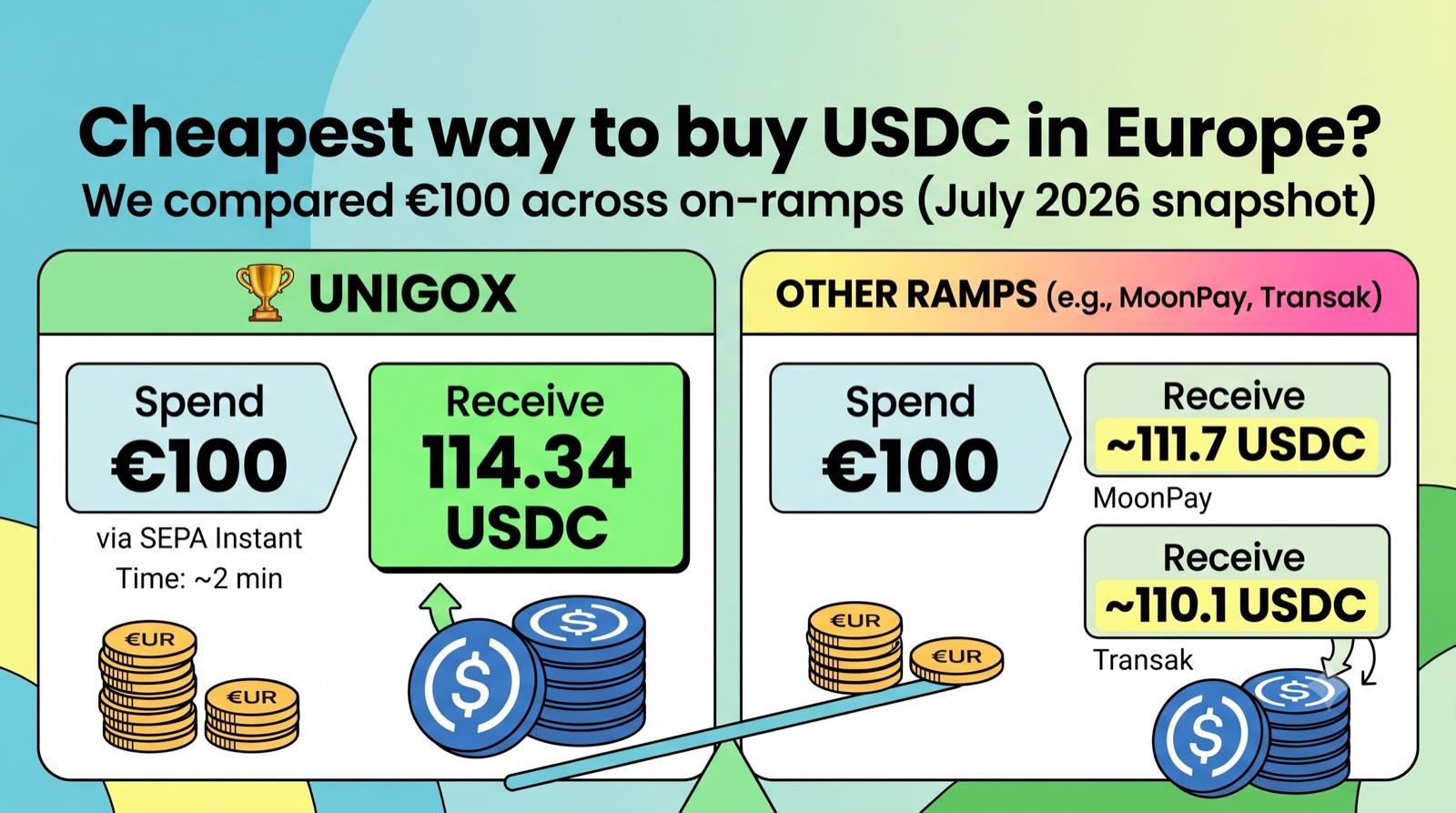
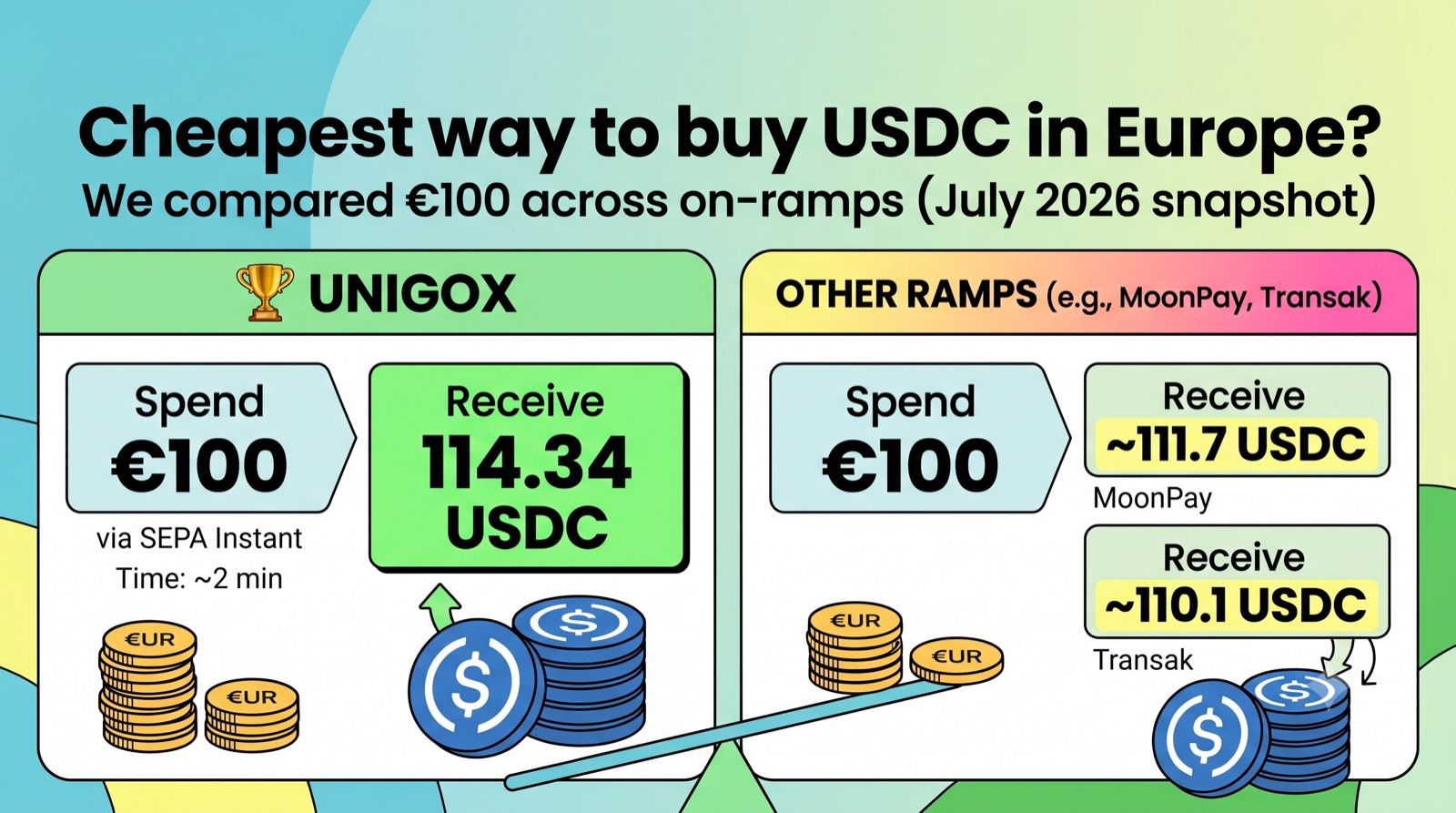
We spent €100 on each of the big EUR→USDC routes on 17 July 2026. Unigox had the best rate: 114.34 USDC for €100, the most of any route we tested. MoonPay returned 111.72, Transak's bank path 110.14. The Unigox buy also finished in about two minutes, because it runs on SEPA Instant.
Rates move all day, so treat this as a snapshot. The way to judge any on-ramp stays the same: fix the amount, read how many USDC you receive, and check how long until you can use them.
Full disclosure: Unigox is our platform. Nothing here requires trusting us: set €100 on any ramp, read the receive amount, and check our math yourself.
How to buy USDC with EUR in Europe
Europe's regulated venues and consumer ramps have tightened around MiCA, and mainstream widgets now treat USDC as the default compliant stablecoin path. So that's the asset we compared.
For most people in Europe the question is: how do I buy USDC with euros, and which route leaves the most coins in my wallet? In plain steps:
- Pick a path that accepts EUR (SEPA bank transfer, SEPA Instant where available, SEPA-friendly apps like Revolut, or a card on-ramp).
- Choose USDC, the stablecoin European ramps treat as the compliant default.
- Compare the receive amount for a fixed spend (€100 is easy to compare).
- Check speed: SEPA Instant is now the default under most EU neobanks and a large share of traditional banks. Don't plan for multi-day settlement unless your bank still runs classic SEPA Credit Transfer only.
- Check whether the quote is wallet delivery or still sitting on an exchange (and whether withdrawal costs more USDC).
€100 in, USDC out
Prices last verified: 17 July 2026 (€100 quotes ~18:53 UTC, €1,000 re-run ~20:51 UTC). Unigox numbers come from our production best-offer API; MoonPay and Transak from their live widgets; exchange rows from public spot books plus published trading and withdrawal fees.
| Path | USDC you get | Fewer USDC than Unigox | Speed (typical) |
|---|---|---|---|
| Unigox (SEPA / Revolut match, 0.5% fee) | 114.34 | - | ~2 minutes after SEPA Instant lands |
| Mid-market reference | ~114.34 | ~0 | - |
| Binance VIP0 + free BSC withdraw | ~114.23 | 0.12 less | Deposit + trade + withdraw (often hours if SEPA not instant) |
| Kraken Pro-style (0.20% + free USDC network) | ~114.11 | 0.23 less | Same: funding lag dominates |
| Binance VIP0 + ERC-20 withdraw (0.6 USDC) | ~113.63 | 0.72 less | Plus chain confirmation |
| Coinbase Exchange path (0.60% + SEPA €0.15) | ~113.48 | 0.86 less | Funding lag + trade |
| MoonPay (default widget) | 111.72 | 2.62 less | Card often faster; bank can lag |
| Transak (manual bank transfer) | 110.14 | 4.20 less | Widget shows ~10–15 min bank path |
What "fewer USDC" means in euros of value
At roughly $1 per USDC:
- 2.62 fewer USDC on MoonPay ≈ you left €2.6 of stablecoin value on the table for €100 spent.
- 4.20 fewer USDC on Transak bank ≈ €4.2 missing per €100.
We re-ran the same test with €1,000 later the same day. The widget gap stays painful, while a disciplined exchange route pulls roughly level:
| Path | €1,000 buys | vs Unigox |
|---|---|---|
| Unigox (SEPA match, 0.5% fee) | 1,140.18 USDC | - |
| Best exchange route (Binance spot + free BSC withdraw) | ~1,142.46 USDC | 2.27 more |
| MoonPay (default widget) | 1,126.30 USDC | 13.88 fewer |
| Transak (bank transfer) | 1,101.90 USDC | 38.28 fewer |
Scaled up, the widget tax is real money: €14–38 of value per €1,000, still denominated in the asset you meant to buy.
Where people lose coins
On-ramps rarely advertise "you get fewer USDC." They say 1%, network fee, processing fee, or bury the cost in a worse FX rate.
Your euros shrink in three places:
- Spread / FX markup: the EUR→USDC rate is worse than mid-market before any line item called a "fee."
- Platform fee: fixed euros or a percent; sometimes both (MoonPay SEPA and card paths are much worse than their default quote).
- Withdrawal / network fee: after you "own" USDC on an exchange, sending it out can cost 0 to ~0.6 USDC depending on chain. Free BSC withdrawals change the math; ERC-20 doesn't.
Card paths are usually the worst consumer option. Bank/SEPA is better. A deep exchange book with a free withdrawal network can match mid-market if you already live in that workflow. Most people don't.
SEPA isn't "wait until Tuesday" anymore
Classic SEPA Credit Transfer can take one business day (sometimes longer across weekends and holidays). That's what many traders still assume when they hear SEPA.
SEPA Instant is different: settlement completes in seconds, 24/7, up to a capped amount. And it isn't optional goodwill: the EU's Instant Payments Regulation (EU) 2024/886 requires euro-area banks to receive instant euro transfers since January 2025 and to offer sending them since October 2025. Neobanks like Revolut and N26 have run on instant rails for years, and most traditional banks now follow. If your banking app labels the payment Instant, or the money simply arrives the same minute, you're not in the old one-business-day world.
On Unigox, the EUR side of a buy is a normal SEPA-style transfer to the matched payment method. When that transfer is Instant, the rest of the flow is built for speed: match, pay, get crypto. In practice users typically finish in about two minutes, not a multi-day bank queue. If your bank only offers standard SEPA, expect the bank's own timeline. That's a bank limitation, not "crypto is slow."
So when you compare on-ramps, ask two questions:
- How many USDC do I get for €100?
- Is the EUR rail Instant, and how long until the coins are actually usable?
Cards can feel instant and still cost you 2–4+ USDC per €100. SEPA Instant on Unigox is meant to give you mid-market coins in minutes.
Unigox in this snapshot
Unigox BUY for €100 USDC:
- 114.34 USDC to the buyer after a 0.5% platform fee
- Matched payment methods in the sample: Revolut / SEPA-style European transfer
- Vendor rate ~0.8746 EUR per USDC
- Typical completion: about two minutes once the SEPA Instant payment lands
That's essentially the mid-market rate for the day. There's no trick to it: you're simply not paying the premium that card and high-fee widgets charge, and you're not waiting days for your money to move.
MoonPay and Transak: the consumer widget tax
MoonPay default widget: 111.72 USDC for €100. 2.62 fewer USDC than Unigox.
Their SEPA and card quotes from the same research day were even lower: around 107 USDC by SEPA and just under that by card. Payment method isn't a footnote. It's most of the cost.
Transak bank transfer widget: 110.14 USDC. 4.20 fewer USDC than Unigox.
These products are convenient. Convenience is priced in missing USDC, not a friendly-looking percent.
Big exchanges: close, if you know the withdraw trick
If EUR is already on Binance and you withdraw USDC on a free network (BSC showed 0 withdraw fee in Binance's public fee list that day), end-to-end math lands around 114.23 USDC for €100 after a 0.10% taker fee. That's only 0.12 USDC behind Unigox.
Switch to ERC-20 and a 0.6 USDC withdraw fee opens a 0.72 USDC gap for the same €100.
Kraken Pro-style stablecoin fees (0.20%) plus free USDC networks: about 114.11 USDC, 0.23 less.
Coinbase Exchange-style path with 0.60% taker and €0.15 SEPA deposit: about 113.48 USDC, 0.86 less.
Exchanges can be fine. They aren't "free" unless you pick the right fee tier and network. And Simple Buy UIs often hide spread until the preview screen.
At €1,000 on the same day, the matched rate was slightly worse and the disciplined exchange paths actually edged 1–2 USDC ahead of Unigox. If you already keep EUR on an exchange and know the free-withdraw networks, that's a genuine path; you're trading a couple of coins against account setup, funding lag, and a manual withdraw. The tax to refuse is the widget tax: even at €1,000, MoonPay and Transak still hand you 14–38 fewer USDC.
How to compare any on-ramp in 30 seconds
- Fix the amount: €100 (or €1,000).
- Select USDC.
- Read You receive. Ignore marketing until you have that number.
- Subtract any withdraw fee if the USDC isn't already in your wallet.
- Prefer SEPA Instant / bank over card unless you're fine paying several USDC for "tap and wait."
- If the product says SEPA, check whether your bank sends Instant (most neobanks do). That's the difference between minutes and "business days."
If a site won't show a receive amount without a full signup, treat that as a yellow flag for comparison shopping.
Bottom line
| If you… | On this snapshot… |
|---|---|
| Want SEPA-style EUR → USDC near mid-market in minutes | Unigox: 114.34 USDC per €100, typically ~2 minutes with SEPA Instant |
| Already live on a CEX and withdraw free (e.g. BSC) | Within a couple of USDC either side of Unigox, depending on size (funding speed varies) |
| Use MoonPay default | 2.62 fewer USDC |
| Use Transak bank | 4.20 fewer USDC |
Cheapest isn't a brand name. It's the highest USDC for the euros you actually send, on a rail that doesn't leave you waiting for a mythical three-day SEPA.
More from us: 5 Paxful alternatives that actually work in 2026 and virtual accounts as an offramp alternative.
Compare live on Unigox: Buy Crypto, EUR → USDC, set €100, read the receive amount, then pay by SEPA Instant. You should be thinking in minutes, not business days.
Quotes as of 17 July 2026. Re-check before you send funds. Markets and fees change.
FAQ
What is the cheapest way to buy USDC in Europe?
In our 17 July 2026 test, a SEPA Instant bank transfer on Unigox gave the most USDC per euro: 114.34 USDC per €100, essentially the mid-market rate. Card widgets were the most expensive route, returning 2–8 fewer USDC per €100 depending on the provider.
How long does buying USDC with SEPA Instant take?
The bank transfer itself settles in seconds, and on Unigox the full purchase (match, pay, receive crypto) typically completes in about two minutes. If your bank only supports classic SEPA transfers, expect up to one business day; that limit comes from the bank, not the platform.
Is buying USDC on a crypto exchange cheaper than using an on-ramp?
It can be close. At larger sizes a disciplined exchange route (spot trade plus a free-network withdrawal) can even come out 1–2 USDC ahead per €1,000, but you pay in workflow: exchange KYC, funding lag, and a manual withdrawal on the right network. Consumer widgets like MoonPay and Transak were 14–38 USDC behind per €1,000 in our test.
Why do card purchases give me fewer USDC?
Card rails carry higher processing costs and fraud risk, and providers pass that on as fixed fees plus a worse EUR→USDC rate. In our test, card routes returned roughly 7–8 fewer USDC per €100 than a SEPA Instant purchase on Unigox. If you can pay by bank transfer, do.
Written by Unigox Team
← Back to blog